Showing posts with label "graphic design". Show all posts

Monday, May 31, 2010

ROXY: 1980's "The Face" - Neville Brody


From 1981 to 1986 Neville Brody was art director of the magazine "The Face", for which he designed a distinctive typographical appearance that inspired magazine designers and other designers worldwide


Neville Brody was a typographer, graphic designer and art director. Brody is perhaps the best known graphic artist of his generation. He uses letters and numbers in his art pieces with an anti-traditional view on art. He played at the margins of visual language and used it to launch a revolution in typeface design.

Brody drew freely to create his visually exciting layouts and typography on avant-garde artistic ideas of the 1920s and 1930s such as those of De Stijl and Russian Constructivism. Far removed from contemporary editorial conventions Brody's work had a studied informality in the thoughtfulness devoted to the construction of its layouts, with blocks of texts often placed horizontally or vertically on the page, their often distinctive layouts contrasting strikingly with hand-mediated imagery and photography. Such ideas exerted a significant international impact on the appearance of magazine, advertising, and retailing design.


The contents spread from The Face's 1982 May edition.


An ad from The Face for dresses.


http://en.wikipedia.org/wiki/The_Face_%28magazine%29
http://en.wikipedia.org/wiki/Neville_Brody
http://www.art-directory.info/design/neville-brody-1957/index.shtml
http://www.answers.com/topic/neville-brody
http://dalstonoxfamshop.blogspot.com/2008/08/face-magazine-may-1982.html

Monday, March 29, 2010

5:PENNY Music/Magazines: Stefan Sagmeister


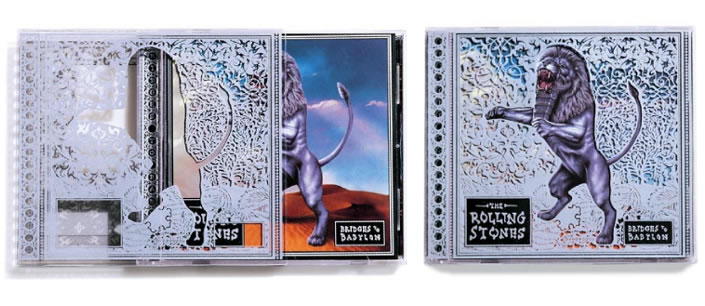
The intent of Stefan Sagmeister in beginning his own Graphic Design company was to allow himself the freedom to design CD covers for the music he appreciated. Over the years, Sagmeister has designed covers, graphics and packaging for musicians such as the Rolling Stones, David Byrne, Lou Reed, Aerosmith, and Pat Metheny. His work in this genre has received four Grammy nominations, and has won many international design awards.


Sagmeister won a Grammy for his work on the Talking Heads collection which features paintings by the Russian contemporary artists Vladimir Dubossarsky and Alexander Vinogradov.


“they contain all of my favourite visual icons: babies bears severed limbs and bare naked people”

Even during Sagmeisters famed year long sabbaticals, he set aside time to design covers.

“The most enjoyable was designing a CD cover every Thursday from 9am to 12pm. I would put any CD that was lying around into the player, start working immediately, and then be done with the whole thing, complete with soft-page booklet and CD label by 12 o'clock.”


Many of Sagmeisters typographical works and experiments have also made their way into magazines and onto posters.
‘Starting A Charity Is Surprisingly Easy’ became the dividing pages opening each new chapter for the Austrian magazine ‘Copy’. Sagmeisters book, ‘Things I Have Learned In My Life So Far’ contains a list of 20 personal quotes, such as ‘Trying To Look Good Limits My Life’ and “Everybody Who Is Honest Is Interesting”, many of these became magazine spreads, billboards, light boxes, annual reports, and fashion brochures.


http://tmagazine.blogs.nytimes.com/2008/02/13/for-the-moment-stefan-sagmeister-3/


http://www.metropolismag.com/story/20080618/brilliant-engaging-but-modest-its-not


http://scene360.com/articles/1186/he-will-make-you-look-an-interview-with-stefan-sagmeister/

http://www.sagmeister.com/sagmeister.html


http://ambidextrousmag.org/issues/10/sagmeister.html

4:PENNY Posters: Audrey Beardsley


"I have one aim—the grotesque. If I am not grotesque I am nothing."

Beardsley was one of the most controversial artists of the Art Nouveau era. He was greatly influenced by Japanese ‘shunga’ and the style’s giant genitalia figured greatly in his later work which often featured grotesque erotica and perverse illustrations.

He was a close friend of Oscar Wilde and illustrated his play ‘Salome’. Among his more famous work is the illustrations for the deluxe edition of Sir Thomas Malory’s, Le Morte d’Arthur.

His work as a Graphic Designer is evident in his work on ‘The Yellow Book’, a magazine at which he was the art editor for the first four editions. ‘The Yellow Book’ was a quarterly literary periodical containing a wide range of literary and artistic material. He was also key in establishing ‘The Savoy’ another magazine of the same style.


He worked in the Arts, creating Posters for theatres, books, plays and magazines; he became a huge influence on the French Symbolists and the Poster Art movement of the 1890’s.


At 25, after a prolific life as an artist, writer and musician, Beardsley died of the tuberculosis which had been slowly killing him since he was a child.


http://www.allposters.com/-st/Aubrey-Beardsley-Posters_c35751_.htm


http://www.artchive.com/artchive/B/beardsley.html


http://www.wormfood.com/savoy/


http://en.wikipedia.org/wiki/Aubrey_Beardsley


http://en.wikipedia.org/wiki/The_Yellow_Book


http://www.all-art.org/symbolism/Beardsley1.html


http://www.britishmuseum.org/explore/highlights/highlight_objects/pd/a/aubrey_beardsley,_self-portrai.aspx

http://ebooks.adelaide.edu.au/b/beardsley/aubrey/art/

Monday, March 8, 2010

2:PENNY Typography: Josef Albers and the Bauhaus


Staatliches Bauhaus, more commonly known as Bauhaus, was the influential art and architecture school founded in Germany in 1919. Bauhaus became most influential on schools of thought in regard to typography, modern design, art, architecture and interior design.
With the belief that artistic forms should be united, practise crafts should be promoted, and all should contribute to a utopian whole.
Typography played a large role in the Bauhaus movement, with many important and famous typefaces finding their roots there: Kombinationsschrift (Joseph Albers), Futura (Paul Renner), Super Grotesk (Arno Drescher) and Universal (Herbert Bayer).

Bauhaus Master Instructors, 1926: From left, Josef Albers, Hinnerk Scheper, Georg Muche, László Moholy-Nagy, Herbert Bayer, Joost Schmidt, Walter Gropius, Marcel Breuer, Vassily Kandinsky, Paul Klee, Lyonel Feininger, Gunta Stölzl and Oskar Schlemmer.

Bauhaus typography was typically unadorned and clean; san-serif types and strong horizontal
and vertical rules were characteristic. They believed: “Typography is an instrument of communication. It must present precise information in a suggestive form… For legibility, the message must never suffer from a priori aesthetics.”

The Architype Albers typeface, designed by Freda Sack and David Quay, is a revival of the typographic experimentation of Bauhaus Professor Josef Albers.
Albers produced sketches for geometrically constructed, universal, sans-serif, stencil typefaces the “Kombinationschrift” alphabets.

He used 10 basic shapes drawn on a grid in a size ratio of 1:3. It consisted of the perfect harmony of circles, squares and rectangles and their combinations, to write any letters or numbers. The system was simple, easy to learn, efficient, cheap for production and expressed purity, regularity and simplicity. The typeface was designed for use on posters and in large scale signs; it was never intended to be used for text.

Albers followed the theory of Die Neue Typographie, or "New Typography". Brought to the Bauhaus by László Moholy-Nagy and put to print by Jan Tschichold in his design manifesto; "New Typography" considered typography to be a medium for communication, and was concerned with the "clarity of the message in its most emphatic form". Albers also followed Herbert Bayer in his hypothesis; since speech does not recognize upper-case letters, they are unnecessary in type.


http://evanmeagher.net/2009/02/lowercase-sans-serifs-for-statistically-worse-readability
http://www.snap2objects.com/2009/09/18/the-bauhaus/
http://www.blogger.com/feeds/2059291324312289780/posts/default
http://www.designhistory.org/Bauhaus3.html
http://www.computerarts.co.uk/in_depth/features/type_of_our_times
http://www.josephdigioia.com/index.php?/thesis/the-new-new-typography/
http://www.scribd.com/doc/24253887/Bauhaus
http://academic.chrissnider.com/bauhaus/pages/people.html
http://www.ltmrecordings.com/bauhausreviewednotes.html

1:PENNY Josef Albers

“In design sometimes one plus one equals three.”


• Albers was born in Bottrop, Westphalia (Germany).
• Initially, a teacher, he taught general elementary school in his hometown of Bottrop, in the north western industrial Ruhr region of Germany between 1908 and 1913
• He studied art in Essen and Munich and was certified as an art teacher after attending the Königliche Kunstschule in Berlin from 1913 to 1915
• Enrolled as a student at the prestigious Weimar Bauhaus in 1920
• Albers independently studied stained glass. He also designed furniture, household objects, a typeface, and developed a keen eye as a photographer.
• Was appointed “journeyman” and placed in charge of the Bauhaus glass workshop
• In 1923 he began teaching in the Preliminary Course in material and design teaching furniture design, drawing, and calligraphy

• On May 9, 1925 he married Anni Albers who was also a student at the Bauhaus
• He was promoted to Professor (Master) in 1925, the year the Bauhaus moved to Dessau. His work at this time included furniture design and work in stained and sandblasted glass, first making glass assemblages from debris he found at the Weimar town dump, then sandblasting glass constructions and designing large stained-glass windows for buildings.
• Funding was withdrawn from the Bauhaus in 1932 and the school moved to Berlin
• In 1933 due to Nazi pressure, the faculty members officially closed the Bauhaus
• Albers immigrated to the United States and joined the faculty of Black Mountain College, North Carolina, an experimental school operating with the principle that fine art integrated all learning.
• Albers ran the painting program until he resigned from Black Mountain 1949

• In the series ‘Homage to the Square’, begun in 1949, Albers explored the interactions of flat coloured squares arranged concentrically. He often made notes recording colours, paints and varnishes as well as the spatial proportions and the mathematical schemes used, on the back of his works, as he wanted people to understand his approach to art.
• From 1950 to 1958 Albers held the position of Chair at the Department of Design at Yale University in New Haven, Connecticut

• Until his death in 1976, Albers had many exhibitions, guest taught and lectured in various universities, was granted fellowships, grants, awards and numerous honorary degrees. He continued to paint and write, including the design of abstract album covers. staying in New Haven with his wife, textile artist Anni Albers
• The Josef Albers Museum was opened in 1983 in Bottrop by his wife Anni Albers


http://www.albersfoundation.org/Home.php

http://www.answers.com/topic/josef-albers

http://en.wikipedia.org/wiki/Josef_Albers

http://www.articons.co.uk/albers.htm

http://www.albers-josef.com/

Monday, February 22, 2010

David Carson


David Carson is a graphic designer best known for his innovative magazine design and use of experimental typography. He was the art director for the magazine Ray Gun and Transworld Skateboarding magazine. Carson was perhaps the most influential graphic designer of the nineties.


By the late eighties he had developed his signature style, using "dirty" type and non-mainstream photographic techniques. He would later be dubbed the "father of grunge."


To the left you can see a page he designed for the Ray Gun Magazine.


Like Neville Brody, typographer and graphic designer David Carson became influential in the late 1980's and 1990s for experimental typeface designs. David Carson's designs were featured heavily in surfing and skateboarding magazines.

A tribute to other self-taught designers, David Carson broke most of the rules of design and typography, a process that was made easy with the use of desk top publishing programs, such as Pagemaker, QuarkXpress and Illustrator. He experimented with overlapping and distorted fonts and intermixed these with striking photographic images.


To view a list of Carson's book's, click here.

http://www.davidcarsondesign.com/
http://en.wikipedia.org/wiki/David_Carson_%28graphic_designer%29
http://www.designtalkboard.com/design-articles/famous-designers.php


1:Stefan Sagmeister

Stefan Sagmeister
Graphic designer and Typographer


"Design that needed guts from the creator and still carries the ghost of these guts in the final execution."


  • Born 1962 in Bregenz, Austria
  • Owned a turtle when very young

  • Began his design career at the age of 15 at "Alphorn", a left wing Austrian Youth magazine
  • After being rejected initially, he studied graphic design at the University of Applied Arts in Vienna
  • Designed posters for the Schauspielhaus theatre group as part of the Gruppe Gut collective
  • Received a Fulbright scholarship to study at the Pratt Institute in New York in 1987
  • Returned to Austria in 1990 for compulsory military service, serving as a conscientious objector, doing community work
  • In 1991, he moved to Hong Kong to work with the advertising agency Leo Burnett
  • 1993, he returned to New York to work Tibor Kalman's M&Co design firm
  • He set up his own company Sagmeister Inc. in 1993
  • 1994 he was nominated for a grammy award for his album cover - 'h. p. zinker mountains of madness’
  • Work has included designed branding, graphics, and packaging for clients as diverse as the Rolling Stones, OK Go, Lou Reed, Aerosmith, HBO, the Guggenheim Museum and Time Warner


  • Sagmeister Inc. remains a small company so as to retain the freedom to choose jobs
  • In 2001 released the book ‘Sagmeister (made you look) (another self-indulgent design monograph)’
  • in 2005 he won a grammy award as art director of the ‘once in a lifetime’ talking heads boxed set packaging
  • Currently working on typographic work ‘20 things in my life I have learned so far.’


and 'style = fart'?
 yes I said this but I had to give up. It was the headline of 
a theory that style and stylistic questions are just hot air
and meaningless. I discovered that this is simply not true.
Through experience I found that if you have content that is
worthwhile, the proper expression of that content, in terms of
form and style is actually very important. It can be a very
useful tool to communicate that content.
I don't think that it is actually hot-air anymore.”

http://www.designboom.com/eng/interview/sagmeister.html
18.2.2010


http://www.sagmeister.com/index.html

http://designmuseum.org/design/stefan-sagmeister
http://en.wikipedia.org/wiki/Stefan_Sagmeister
http://www.designboom.com/eng/interview/sagmeister.html
http://www.designobserver.com/observermedia/audiofile.html?entry=11857
http://www.typotheque.com/articles/how_good_is_good
http://www.ted.com/talks/stefan_sagmeister_shares_happy_design.html

Monday, February 15, 2010

Neville Brody


Neville Brody was a typographer, graphic designer and art director. Brody is perhaps the best known graphic artist of his generation. He uses letters and numbers in his art pieces with an anti-traditional view on art. He played at the margins of visual language and used it to launch a revolution in typeface design.

Brody is also well known for being one of he first people to use a Mac computer to create his designs.


An ad Brody made for Nike

Brody first began work on record cover designs and then progressed to working as the Art Director for The Face Magazine between 1981 and 1986.


A copy of The Face magazine printed in the 1980's.


Brody has pushed the boundaries to visual communication on many different platforms of media using exploratory creative expression.

He was also partly responsible for instigating the FUSE project an influential fusion between a magazine, graphics design and typeface design

Notable fonts he helped create include the updated font for the Times newspaper, Times Modern.


Neville Brody made famous a job which, under normal circumstances, would remain obscure.

To view some of the fonts he created, click here.
To see an over view of his book "The Graphic Design Language" click here.